
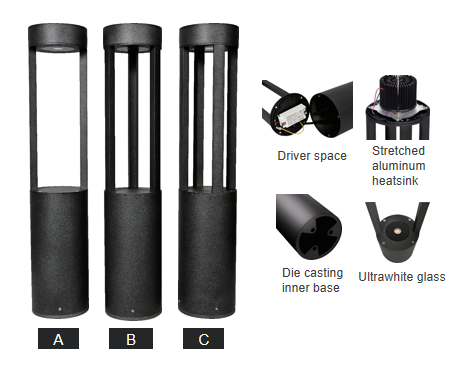
In many outdoor lighting projects, spacing is where things quietly go wrong.
Not because engineers don’t know lighting —
but because spacing is often treated as a quick decision instead of a design variable.
Too far apart, and you get dark gaps.
Too close, and you get glare, wasted energy, and unnecessary cost.
In real projects, spacing is not just about distance —
it directly affects how people experience the space.
1️⃣ What Good Spacing Actually Means
Good spacing is not “even spacing.”
It means:
- No visible dark gaps between fixtures
- Comfortable, continuous guidance for walking
- Light levels that feel natural, not overlit
- Consistency across the whole pathway
In other words,
people shouldn’t notice the lights — only the clarity of the path.
2️⃣ Typical Spacing Ranges (Real Projects)
From practical projects, bollard spacing usually falls into:
- 2.5m – 4m → Residential pathways, villas
- 3m – 5m → Parks, public walkways
- 4m – 6m → Wide paths or low-output fixtures
But these are only starting points.
Actual spacing depends on:
- Beam distribution
- Fixture height
- Lumen output
- Ground reflectance
That’s why copying spacing from another project often doesn’t work.
3️⃣ The Most Common Mistake: “Too Far Apart”
This happens a lot when trying to reduce cost.
What you get:
- Dark zones between fixtures
- Uneven visibility
- Poor perception of safety
And in reality:
👉 The project doesn’t feel finished
👉 Users don’t feel comfortable walking
In many cases,
slightly reducing spacing improves the project more than increasing brightness.
4️⃣ Glare vs Spacing: A Hidden Trade-off
When fixtures are too close:
- Light overlaps excessively
- Bright spots appear
- Visual comfort drops
Especially with poorly shielded fixtures,
closer spacing can actually make the space harder to navigate.
That’s why anti-glare design + correct spacing must work together.
5️⃣ Real Design Approach (Simple but Effective)
In practical projects, a better approach is:
👉 Start from light distribution, not distance
Step-by-step:
- Choose fixture type (louver / shielded / open)
- Check light spread pattern
- Place fixtures based on overlap of light distribution
- Adjust spacing based on site condition
This avoids both:
- Under-lighting
- Over-lighting
6️⃣ Maintenance and Future Considerations
Spacing also affects long-term usability:
- Too tight → more fixtures to maintain
- Too wide → difficult troubleshooting (dark areas unclear)
Good spacing makes:
- Inspection easier
- Replacement simpler
- System more predictable
🔚 Final Thought
In outdoor lighting, spacing is not just a number.
It’s what defines:
- Safety
- Comfort
- Project quality
A well-spaced bollard layout doesn’t stand out —
but it’s exactly what makes a project feel right.