
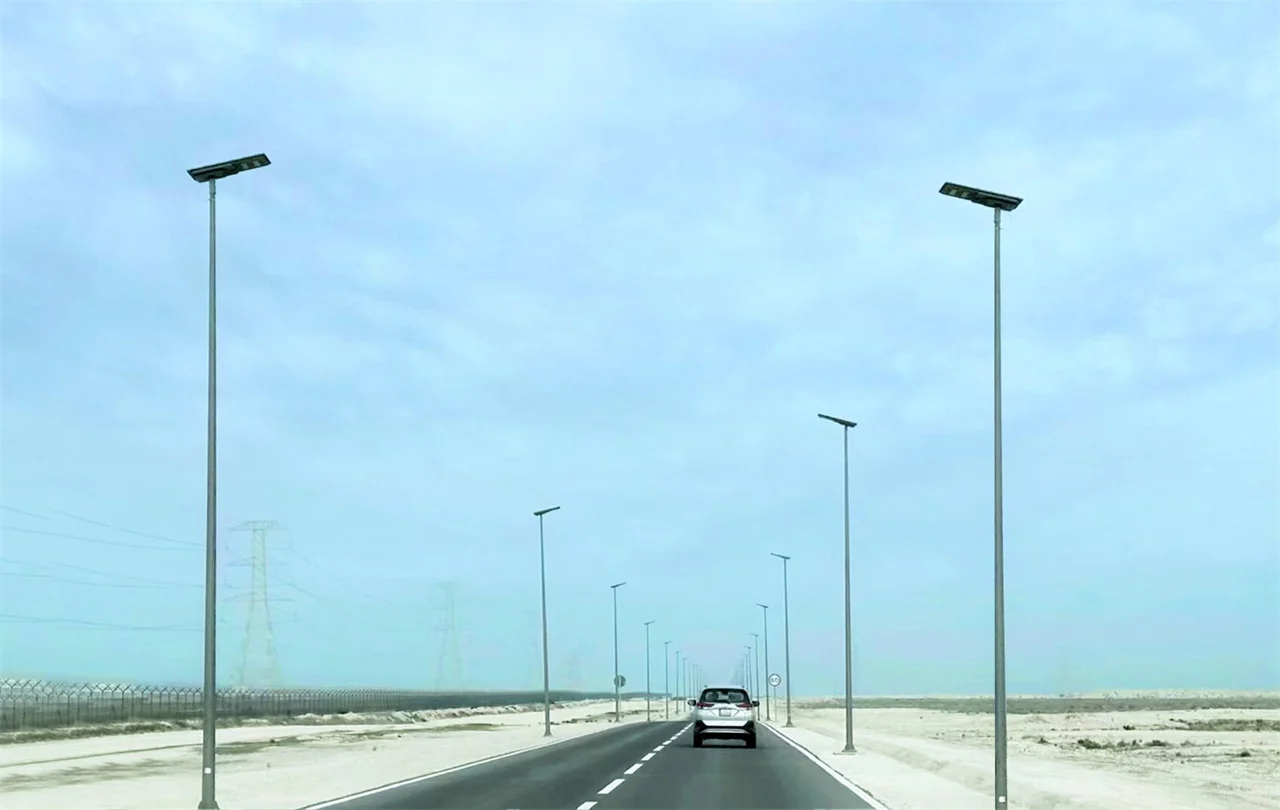
Specifying the correct wattage for an outdoor solar street light is not just about brightness. It directly impacts pole foundation costs, total system budget, and whether the roadway meets international illumination standards.
Many contractors make the mistake of either over-specifying 100W luminaires for narrow access paths—driving up procurement budgets unnecessarily—or installing low-powered 30W units on wide public roads, creating dangerous dark patches between poles.
This practical guide provides a direct road-matching framework to help contractors, municipalities, and engineers match the right wattage (30W, 60W, or 100W) to specific pole heights, road widths, and layout configurations.
Understanding the Difference: Lumens vs. Rated Wattage
When comparing 30W, 60W, and 100W fixtures, the key performance indicator is total luminous flux (measured in lumens) and optical distribution:
- 30W Systems (3,600 to 4,800 Lumens): Engineered for low mounting heights. They deliver uniform, glare-free light over tight coverage areas without wasting energy.
- 60W Systems (8,000 to 10,200 Lumens): The standard workhorse for modern municipal and commercial infrastructure, offering the ideal balance between brightness and coverage area.
- 100W Systems (14,000 to 18,000 Lumens): High-output industrial luminaires designed for wide arterial roads, heavy-traffic corridors, and large perimeter compounds.
Project Sizing Matrix: Wattage, Pole Height, and Pole Spacing
The table below outlines recommended engineering parameters based on standard Type II and Type III road lighting distributions:
| Application & Road Type | Road Width | Recommended Wattage | Mounting Pole Height | Pole-to-Pole Distance | Lighting Layout Pattern |
| Rural Pathways & Village Roads | 3 to 4 meters | 30W | 4 to 5 meters | 12 to 15 meters | Single-side arrangement |
| Factory Perimeters & Park Walkways | 4 to 6 meters | 30W – 60W | 5 to 6 meters | 15 to 18 meters | Single-side arrangement |
| Two-Lane Secondary Urban Roads | 6 to 8 meters | 60W | 6 to 7 meters | 20 to 25 meters | Single-side arrangement |
| Four-Lane Municipal Main Arterials | 10 to 14 meters | 100W | 8 to 10 meters | 25 to 30 meters | Staggered opposite arrangement |
| Highway Interchanges & Logistics Yards | 12 to 16+ meters | 100W – 120W+ | 9 to 12 meters | 30 to 35 meters | Dual-sided opposite arrangement |
Scenario 1: When to Specify 30W Solar Street Lights
Best For: Village road programs, private farm estates, resort walkways, residential HOA access lanes, and perimeter security fences.
- Engineering Considerations: At 4 to 5 meters pole height, 30W units provide clear ground lux (typically 10 to 15 lux) without blinding pedestrians or drivers.
- Cost Advantage: Because energy draw is low, 30W systems require compact solar panels and lightweight lithium battery packs. This reduces shipping freight, minimizes wind drag, and allows installation on standard light-duty poles without heavy concrete footings.
- Recommended System: Compact integrated fixtures like the PE-6050SL Modular Foldable Solar Street Light allow fast deployment by small local crews without specialized crane trucks.
Scenario 2: When to Specify 60W Solar Street Lights
Best For: Two-lane municipal roads, commercial business parks, school campuses, parking lots, and industrial access roads.
- Engineering Considerations: Installed at 6 to 7 meters high, a quality 60W LED luminaire delivers 15 to 25 lux average ground illumination across standard 7-meter wide asphalt roadways.
- Spacing Efficiency: A 60W fixture paired with batwing Type II or Type III optics can achieve a pole spacing of 20 to 25 meters while maintaining an overall uniformity ratio (U0) above 0.4, eliminating zebra-stripe lighting patterns.
Scenario 3: When to Specify 100W Solar Street Lights
Best For: Four-lane public transit corridors, municipal highways, toll plazas, mining facilities, and seaport container terminals.
- Engineering Considerations: Higher mounting heights (8 to 10 meters) are required to spread high-intensity light evenly across multi-lane roadways without creating severe glare.
- Thermal and Battery Demands: Running 100W of high-output LEDs for 10 to 12 hours continuous duty requires a heavy-duty photovoltaic array and an industrial-grade LiFePO4 battery bank.
- Recommended System: Heavy commercial projects require modular split systems like the PE-6060SL Heavy-Duty Hybrid Solar Street Light, where the large solar panel can be oriented independently for maximum sun harvest while protecting the battery chemistry in a dedicated housing.
3 Rules of Thumb to Avoid Site Layout Errors
- Never exceed the 3.5x to 4x Height-to-Spacing Ratio: If your mounting height is 6 meters, your maximum distance between poles should not exceed 24 meters. Exceeding this creates dark blind spots between fixtures.
- Account for Overhang and Boom Angle: For road widths wider than 8 meters, ensure the light arm features a 10 to 15 degree upward tilt. This projects the core beam toward the road centerline rather than pooling light directly under the pole base.
- Verify Battery Autonomy for Your Region: In cloudy or monsoon-prone areas, always confirm the internal battery storage provides at least 3 nights of reserve capacity based on your programmed lighting schedule.
Get a Free Dialux Photometric Simulation for Your Project
Choosing between 30W, 60W, and 100W configurations depends on exact road geometry, surface reflection (asphalt vs. concrete), and tender specifications.
SPE Lighting supports international contractors and municipal buyers with full photometric validation and commercial lighting supply.
- Explore Our Core Products:
- PE-6050SL Modular Foldable Solar Street Light – Ideal for 30W to 60W integrated pathways and commercial perimeter lighting.
- PE-6060SL Heavy-Duty Hybrid Solar Street Light – High-output modular system for 60W to 120W+ municipal arterial and highway tenders.
- Request Project Support: Contact SPE Lighting with your road width and pole spacing parameters to receive a complimentary Dialux 3D Photometric Layout Report and factory-direct project quotation.