
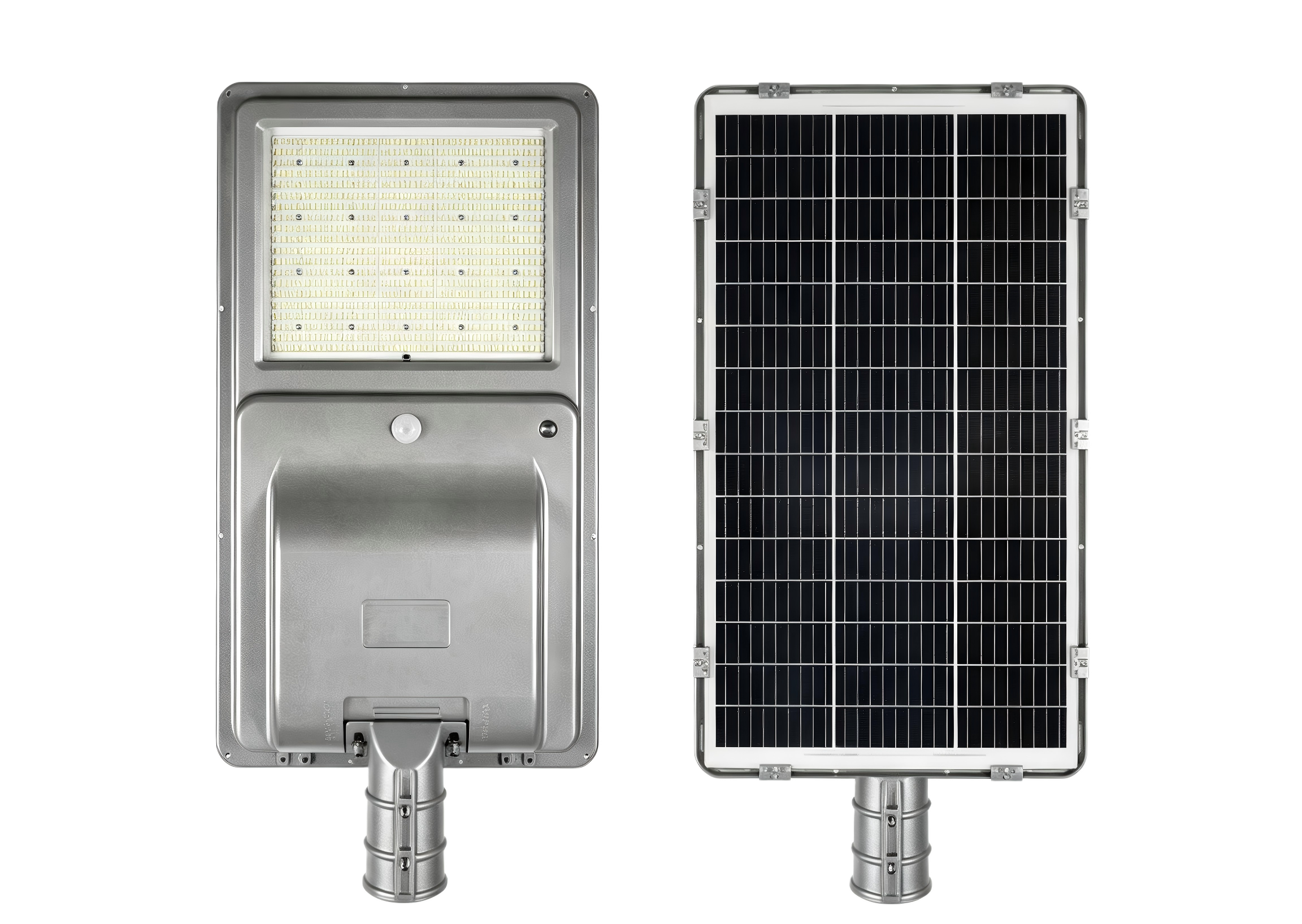
Choosing the right solar street lighting system is often the defining factor for the success, budget compliance, and long-term reputation of a commercial or municipal project. When project managers, electrical contractors, and municipal buyers evaluate tenders, the debate almost always narrows down to two core architectures: All-in-One (Integrated) and Split-type (Modular) systems.
Choosing the wrong configuration leads to premature battery failure in scorching climates, insufficient lighting during extended monsoon seasons, or bloated installation labor costs. This guide breaks down the structural differences, engineering trade-offs, and optimal deployment scenarios to help you specify the right system for your next project.
System Architecture & Core Components
1. All-in-One Solar Street Lights (Integrated)
In an All-in-One system, the solar panel, lithium battery, LED light source, motion sensor, and charge controller (MPPT/PWM) are housed within a single, streamlined fixture.
- Mounting: Mounted directly onto a pole via an adjustable bracket.
- Key Advantage: Minimal wiring, rapid plug-and-play installation, and a compact footprint that drastically cuts freight and labor costs.
- SPE Engineered Example: Models like the PE-6050SL Modular Foldable Solar Street Light combine integrated convenience with flexible module adjustments, streamlining both logistics and field setup.
2. Split-Type Solar Street Lights (Modular)
In a Split-type system, components are decoupled. The heavy-duty solar panel is mounted at the very top of the pole facing the optimal sun angle, while the LED luminaire, battery pack, and controller are housed in a separate enclosure (often secured lower down the pole or integrated into a protective housing).
- Mounting: Separate brackets for panels and fixtures, with heavy-duty cables interconnecting them.
- Key Advantage: High structural flexibility, massive power scaling capabilities, and superior thermal management.
- SPE Engineered Example: Heavy-duty applications rely on configurations like the PE-6060SL Heavy-Duty Hybrid Solar Street Light, designed to deliver continuous, high-output lighting for wide highways and demanding commercial infrastructure.
Technical Comparison Matrix
| Evaluation Metric | All-in-One (Integrated) | Split-Type (Modular) |
| Power Capacity Range | Typically 30W – 120W LED | 60W – 300W+ (High-lumen municipal grade) |
| Solar Panel Orientation | Fixed or semi-adjustable tilt angles | Fully adjustable tilt angle optimized for latitude |
| Battery Placement & Thermal Health | Integrated inside the fixture housing | Housed in shaded enclosures or secure pole-mounted compartments |
| Installation Labor & Time | Very low (1–2 workers can install multiple units per hour) | Higher (requires lift equipment and inter-component cabling) |
| Wind Resistance | Compact profile with low wind-load drag | Larger panel surface area requires heavy-duty pole engineering |
| Primary Deployment | Rural roads, industrial perimeters, pathways, parking lots | Highways, multi-lane arterial roads, heavy industrial complexes |
4 Critical Decision Factors for Project Engineers
1. Thermal Management & Climate Reality
Battery longevity is the single biggest variable in solar lighting ROI. Lithium Iron Phosphate ($\text{LiFePO}_4$) batteries degrade rapidly if subjected to sustained excessive heat.
- The All-in-One Challenge: Because the battery sits directly behind the solar panel and inside the luminaire casting, midday ambient solar heat combined with charging cycles can drive internal temperatures up. Smart thermal management and quality BMS protection are mandatory.
- The Split-Type Advantage: Decoupling the battery enclosure from the direct solar thermal load keeps the chemistry running cooler, making split systems the preferred standard for harsh desert environments (such as the Middle East and North Africa).
2. Power Output and Lux Requirements
If your municipal tender calls for lighting a 4-lane highway requiring high-uniformity Class M illumination (e.g., 150W+ continuous LED output running at full brightness for 12 hours), an integrated chassis physically cannot accommodate the oversized panel surface and battery bank required. Split systems like the PE-6060SL Heavy-Duty Series accommodate large photovoltaic arrays and high-capacity storage banks to meet rigid roadway criteria.
3. Installation Budget & Logistics
For island infrastructure or rural road electrification in Southeast Asia, labor availability and heavy crane rentals drive up overall budgets.
- Integrated fixtures like the PE-6050SL Modular Series eliminate specialized on-site wiring teams. Road crews can mount them directly onto standard poles in minutes, reducing deployment costs by up to 40%.
4. Maintenance and Servicing
- All-in-One: Components are sealed tightly aloft, deterring vandalism and casual tampering. Servicing usually involves swapping out modular driver/battery compartments or taking down the compact fixture.
- Split-Type: Batteries and controllers are accessible on the pole or at the base for routine inspection, but external cabling requires armor-sleeved conduits in areas prone to theft.
Summary Recommendation: Which Should You Specify?
- Choose All-in-One if: You are specifying lighting for commercial parks, secondary access roads, perimeter fences, or rural community lighting where rapid deployment, clean aesthetics, and tight labor budgets take precedence. Check the PE-6050SL Modular Foldable Solar Street Light for full specifications.
- Choose Split-Type if: You are bidding on government highway tenders, primary arterial routes, toll plazas, or projects in regions with extreme ambient heat requiring high-wattage autonomous runtime. Review the PE-6060SL Heavy-Duty Hybrid Solar Street Light technical parameters.
Optimize Your Next Lighting Tender
Need precise engineering support, Dialux photometric layouts, or a competitive bill of quantities (BOQ) quote for your upcoming project?
- Explore Our Core Products:
- Request Dialux Simulations & Specifications: Contact Our Engineering Team directly to receive lighting distribution curves, wind-load ratings, and customized B2B project pricing.