
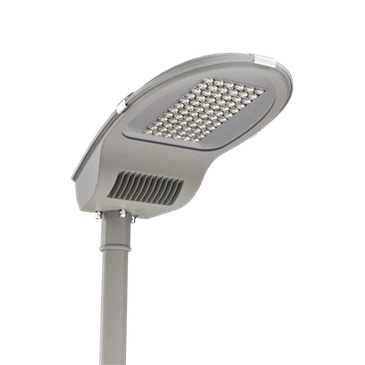
When planning a commercial access road, industrial park lighting upgrade, or community street retrofit, project contractors and property developers often face a core decision: should you install standard grid-connected AC LED street lights, or switch to off-grid solar street lights?
Both technologies utilize high-efficiency LED chips, yet their infrastructure requirements, capital expenditure (CAPEX), and ongoing operating costs differ dramatically. Selecting the wrong type can either blow your installation budget on unnecessary trenching or lead to premature battery replacements in areas where grid power is already readily available.
This practical comparison guide breaks down the financial and operational trade-offs to help electrical contractors and facility managers specify the most cost-effective lighting system.
Understanding the Core Differences
1. AC Grid-Tied LED Street Lights
Grid-tied LED street lights run on standard alternating current (100V–277V AC). They connect directly to existing underground or overhead municipal utility lines.
- Best Advantage: Continuous, unlimited nighttime illumination with zero reliance on weather conditions or battery storage.
- Primary Cost Factor: High initial trenching, cabling, and transformer labor costs if underground electrical infrastructure is not already present.
2. Off-Grid Solar Street Lights
Solar street lights operate independently of the electrical grid, using an integrated or split photovoltaic panel to charge a built-in lithium battery during daylight hours.
- Best Advantage: Zero utility power bills and 100% savings on ground trenching, cabling, and electrical permits.
- Primary Cost Factor: Slightly higher upfront luminaire cost (due to battery and solar panel integration) and periodic battery maintenance every 5 to 8 years.
Head-to-Head Comparison: Grid LED vs. Solar Street Lights
| Decision Factor | Grid-Tied AC LED Street Lights | Off-Grid Solar Street Lights |
| Grid Dependency | Requires active utility power lines | 100% independent off-grid operation |
| Trenching & Cabling | Mandatory (PVC conduits, copper wires, pull boxes) | Zero ground excavation or cabling required |
| Installation Speed | Moderate to slow (depends on electrical permits and wiring) | Extremely fast (plug-and-play pole mounting) |
| Ongoing Electricity Bills | Ongoing monthly utility expenses | Zero ongoing energy utility cost |
| Continuous Operation | Operates normally regardless of extended rainy days | Requires engineered battery autonomy (typically 3–5 nights) |
| Ideal Project Locations | Urban avenues, existing pole retrofits, heavy highway networks | Remote access paths, private estates, perimeter fences, island resorts |
Scenario A: When You Should Specify Grid-Connected LED Street Lights
1. Existing Utility Infrastructure Is Already in Place
If your project involves retrofitting older High-Pressure Sodium (HPS) or Metal Halide (MH) fixtures where underground wiring and poles already exist, swapping directly to modern Commercial LED Street Lights is the most cost-effective route. You achieve immediate 60% to 70% energy savings without touching the ground cabling.
2. High-Speed Highways and Heavy Traffic Arterials
Busy expressways requiring continuous 150W to 300W high-lux illumination throughout the entire night without any power dimming are best served by reliable AC-powered luminaires with dedicated 10kV surge protection.
3. Heavily Shaded Urban Canopies
Streets lined with tall buildings or dense tree canopies block direct sunlight, preventing solar panels from achieving proper daily charging cycles. In these areas, grid-connected fixtures remain the only dependable option.
Scenario B: When You Should Specify Off-Grid Solar Street Lights
1. Remote Roads and Greenfields Without Grid Access
Extending an AC power grid just 500 meters down a private road or farm perimeter can cost thousands of dollars in trenching machinery, copper wiring, and utility permits. In off-grid scenarios, installing all-in-one solar fixtures eliminates cable costs entirely.
2. Fast-Track Community and Commercial Perimeter Projects
For private logistics parks, schools, and rural roadways requiring immediate lighting without waiting months for utility approvals, compact modular fixtures like the PE-6050SL Modular Foldable Solar Street Light can be mounted directly onto existing light-duty poles in 15 minutes.
3. Heavy-Duty Coastal and Remote Arterials
For wide coastal corridors and sunny arterial routes where grid stability is poor, hybrid systems like the PE-6060SL Heavy-Duty Hybrid Solar Street Light combine large monocrystalline solar panels with high-capacity LiFePO4 batteries to ensure continuous, blackout-proof illumination.
3 Questions to Finalize Your Lighting Specification
- Question 1: Does the site have existing, working underground wiring?
- Yes: Choose grid-tied AC LED street lights to keep equipment procurement costs low.
- No: Choose solar street lights to bypass expensive ground trenching and copper cables.
- Question 2: What are the local Peak Sun Hours (PSH)?
- If the region receives at least 3.5 to 4.5 peak sun hours daily, solar street lights deliver rapid payback within 12 to 24 months.
- Question 3: How fast does the lighting need to be commissioned?
- Solar street lights can be deployed immediately without utility grid coordination, making them ideal for quick-turnaround contractor handovers.
Partner Directly with SPE Lighting: Factory Direct Roadway Solutions
Whether your upcoming installation calls for high-efficiency AC roadway fixtures or self-contained off-grid solar units, SPE Lighting provides contractor-grade hardware backed by factory-direct warranties.
- Explore Our Lighting Lines:
- Commercial LED Street Lights – Heavy-duty die-cast ADC12 aluminum fixtures from 30W to 400W with 10kV SPD and standard smart NEMA/Zhaga sockets.
- PE-6050SL Modular Foldable Solar Street Light – High-turnover, low-freight-volume integrated solar solution for pathways and perimeters.
- PE-6060SL Heavy-Duty Hybrid Solar Street Light – High-output modular solar platform for wide municipal and commercial avenues.
- Request Wholesale Pricing & Project Quotations: Have a bill of quantities (BOQ) or need sample units for testing? Contact Our Commercial Sales Team or email us directly at
info@spelighting.comto receive technical spec sheets, IES photometric files, and fast B2B pricing.