
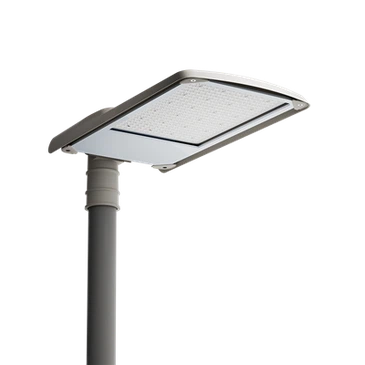
Upgrading municipal expressways, industrial park avenues, or urban roadway networks to modern LED street lighting requires balancing optical performance, electrical reliability, and long-term operating costs. For EPC contractors and electrical project managers, a successful lighting tender depends on more than just wattage and pricing.
Specifying an inferior LED roadway fixture often leads to premature driver failure from grid power surges, severe lumen degradation caused by poor thermal dissipation, or failed municipal inspections due to uneven ground lux distribution.
This technical procurement guide details the critical engineering parameters required to specify roadway luminaires, comply with municipal tender standards, and partner with a reliable OEM/ODM manufacturer.
1. System Luminous Efficacy and Energy Payback
When calculating Return on Investment (ROI) for commercial street lighting retrofits, system efficacy (lumens per watt, lm/W) is the critical metric.
- Legacy vs. Modern LED: High-Pressure Sodium (HPS) and Metal Halide (MH) lamps operate around 60 to 90 lm/W with significant light wasted in non-directional scattering. Modern commercial LED luminaires deliver 140 to 170 lm/W directly onto the road surface.
- Tender Sizing Advantage: Selecting higher-efficacy fixtures allows engineers to reduce required wattage without compromising road brightness. For example, replacing a traditional 250W HPS lamp with a high-efficiency 80W to 100W LED roadway light delivers over 60% energy savings while meeting standard Class M roadway lux levels.
- Component Selection: Look for luminaires built with Tier-1 LED chips (such as Lumileds, Cree, or Osram) paired with high-efficiency constant-current drivers maintaining a Power Factor (PF) greater than 0.95.
2. Thermal Management: ADC12 Die-Cast Chassis
Heat is the primary cause of LED junction degradation and premature capacitor failure inside electronic drivers.
- High-Pressure Die-Cast Aluminum: Industrial roadway luminaires must utilize rugged ADC12 or A380 low-copper die-cast aluminum housings. This provides high thermal conductivity, drawing heat away from the LED circuit board to external cooling fins.
- Integrated Heat Sinking: Avoid fixtures that rely on thin sheet-metal or plastic backing. A unibody die-cast heatsink ensures the LED junction temperature ($T_j$) remains well below 75 degrees Celsius under continuous night-time operation, guaranteeing an L70 lifetime exceeding 50,000 to 100,000 hours.
- Aerodynamic & Self-Cleaning Geometry: A smooth, sloped luminaire housing prevents the accumulation of leaves, road dust, and bird droppings. Natural rainwater washes the surface clean, preventing hotspot insulation that traps heat.
3. Electrical Immunity: 10kV Surge Protection Devices (SPD)
Outdoor roadway lighting grids are constantly exposed to severe voltage spikes caused by lightning strikes and utility switching transients.
- Internal vs. External SPD: Standard built-in driver surge suppression (often rated at only 2kV to 4kV) is inadequate for open municipal highways and bridge overpasses.
- Industrial Standard: Robust roadway fixtures must integrate a dedicated commercial-grade 10kV or 20kV Surge Protection Device (SPD) upstream of the driver.
- Field Serviceability: The SPD should shield sensitive driver electronics and LED boards against high-energy utility fluctuations, significantly reducing truck-roll maintenance costs.
4. Precision Road Optics and Dialux Simulation Compliance
Lighting a multi-lane highway requires uniform light distribution (U0 > 0.40) and minimal glare (TI < 10% to 15%) to ensure driver safety.
- Optical Distribution Curves:
- Type II: Ideal for narrow two-lane roadways, pedestrian avenues, and parking perimeters (forward throw with wide lateral spread).
- Type III: Engineered for multi-lane urban arterials, highway interchanges, and wide commercial entrances.
- Type IV / Type V: Applied at intersections, roundabouts, and broad logistics yards.
- Anti-Glare Optics: Optical-grade, UV-stabilized polycarbonate (PC) or tempered glass lenses ensure uniform batwing distribution, eliminating zebra-stripe lighting patterns on asphalt and concrete pavement.
5. Smart City Infrastructure: NEMA & Zhaga Receptacles
Municipal tenders increasingly mandate smart lighting controls to reduce operating expenses through automated dimming and centralized monitoring.
- NEMA Sockets (ANSI C136.41): Standard 3-pin, 5-pin, or 7-pin twist-lock NEMA receptacles support basic daylight photocells, 0-10V dimming controllers, and smart city nodes.
- Zhaga Book 18 Sockets: Compact, low-voltage DC sockets tailored for digital DALI-2 drivers, integrated PIR/microwave motion sensors, and IoT smart municipal gateways.
- Future-Proofing: Specifying luminaires with pre-installed NEMA or Zhaga sockets enables plug-and-play smart sensor upgrades at any point during the project lifecycle without rewiring the fixture.
Commercial LED Street Light Specification Checklist
| Feature | Standard Specification | Municipal Highway Tender Grade |
| System Efficacy | 130 – 140 lm/W | 160 – 170+ lm/W |
| Housing Material | Standard recycled aluminum | Low-copper ADC12 die-cast aluminum |
| Ingress & Impact Protection | IP65 / IK07 | IP66 Weatherproof / IK08 – IK09 Impact Rated |
| Surge Protection (SPD) | 4kV – 6kV (driver internal) | 10kV / 20kV dedicated commercial SPD |
| Optical Distribution | Standard wide beam | Precision Type II / Type III Batwing Roadway |
| Smart Control Ready | Fixed output / Manual photocell | Standard 7-Pin NEMA or Zhaga Book 18 Socket |
| Certification & Lifespan | CE / RoHS, 30,000 hrs | CE / CB / RoHS, L70 > 50,000–100,000 hrs |
Accelerate Your Next Roadway Tender with SPE Lighting
Winning a municipal roadway tender or executing a commercial retrofit requires factory-direct pricing, rapid IES photometric validation, and dependable mechanical quality.
SPE Lighting manufactures industrial and commercial AC LED Street Lights covering 20W to 400W configurations for urban avenues, bridge overpasses, industrial estates, and smart-city retrofits.
- Explore Our Roadway Product Line: Browse high-output models from 30W to 400W in our Commercial LED Street Light Catalog, featuring ADC12 die-cast bodies, Tier-1 driver electronics, 10kV surge protection, and NEMA/Zhaga smart sockets.
- Fast 24-Hour Dialux Simulation: Provide us with your road width, pole height, and pole spacing parameters to receive a complimentary, project-ready 3D Dialux lux calculation report.
- Request a Factory-Direct BOQ Quote: Have an upcoming project tender or bill of quantities? Contact Our Engineering Sales Team or email us directly at
info@spelighting.comto receive technical spec sheets, IES files, and competitive B2B export pricing.