
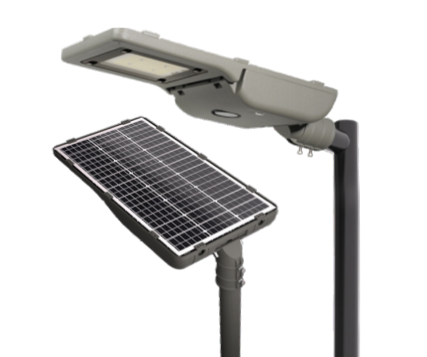
For municipal engineers and EPC contractors developing coastal highways, island resorts, and tropical rural roads in regions like the Philippines, Jamaica, and West Africa, off-grid solar street lighting offers an ideal solution. It eliminates trenching and independent grid extensions across challenging terrain.
However, tropical and coastal environments present severe engineering challenges. Salt spray accelerates housing corrosion, high humidity compromises sensitive electronic drivers, and seasonal monsoons or typhoons exert heavy aerodynamic stress on solar arrays.
Deploying standard commercial-grade luminaires in these climates often leads to structural failure, water ingress, or premature battery degradation within 12 to 18 months. This technical guide outlines the engineering criteria required to design and specify resilient solar street lighting systems for extreme island and coastal infrastructure.
1. Combating Salt Mist Corrosion: Metallurgy and Surface Treatments
Airborne chlorides in coastal zones rapidly attack standard aluminum alloys, resulting in galvanic corrosion, pitted surfaces, and compromised waterproof seals.
- Die-Cast Aluminum Quality: Coastal luminaires must utilize low-copper die-cast aluminum alloys (such as ADC12 or A380). Low copper content minimizes the internal electrolytic potential that accelerates pitting.
- Surface Pre-Treatment & Powder Coating: Standard paint finishes degrade quickly under intense ultraviolet (UV) radiation and salt exposure. Luminaires require multi-stage conversion coatings (such as chromate or zirconium passivation) followed by architectural-grade electrostatic polyester powder coating.
- Salt Spray Validation: Ensure the luminaire housing has undergone rigorous laboratory validation, achieving at least 500 to 1,000 hours of ASTM B117 salt spray testing without coating blistering or creepage.
- Hardware & Fasteners: All external screws, nuts, brackets, and adjustable clamps must be strictly 304 or 316 marine-grade stainless steel to prevent seized hardware and rust staining during field service.
2. Moisture and Ingress Protection: Surviving Tropical Monsoons
Sudden tropical downpours create extreme pressure differentials between the interior of a sealed luminaire and the external ambient air.
- True IP66/IP67 Ingress Protection: A reliable outdoor fixture requires a certified IP66 or IP67 rating. Continuous-pour anti-aging silicone gaskets ensure long-term elasticity and prevent water ingress under heavy driving rain.
- Breather Valves (Pressure Equalization): High internal operating temperatures during the day, followed by rapid cooling during sudden storms, create a vacuum that pulls moisture past standard gaskets. Incorporating an ePTFE waterproof breathable vent equalizes internal pressure while keeping water droplets and humidity out.
- Conformal Coating on PCBAs: Moisture ingress can cause short circuits on LED driver boards and MPPT charge controllers. All internal printed circuit board assemblies (PCBAs) should feature robotic conformal coating (silicone or polyurethane resin) to isolate components from lingering humidity and microscopic moisture films.
3. Thermal Management and Battery Protection in High Humidity
Tropical coastal regions frequently combine $35^\circ\text{C}+$ daytime ambient temperatures with relative humidity exceeding 85%. This environment places intense stress on energy storage systems.
- Lithium Iron Phosphate ($\text{LiFePO}_4$): Compared to traditional ternary lithium ($\text{NMC}$) or lead-acid chemistries, $\text{LiFePO}_4$ offers superior thermal stability, withstanding ambient cell temperatures up to $60^\circ\text{C}$ without thermal runaway.
- Intelligent BMS Throttling: The integrated Battery Management System (BMS) must incorporate multi-point temperature sensors. If midday internal temperatures spike, the BMS regulates charge current to protect cell chemistry, switching back to full charging speed as temperatures stabilize.
- Integrated vs. Split Thermal Isolation: In compact modular units like the PE-6050SL Modular Foldable Solar Street Light, the battery compartment is isolated from direct luminaire heat dissipation channels, maximizing cycle life (over 2,000–3,000 cycles at 80% DOD).
4. Aerodynamic Engineering & Typhoon Wind-Load Resistance
Islands and coastal corridors regularly encounter high gale-force winds, monsoons, and typhoons exceeding Category 3 speeds.
Wind Pressure Formula: P = 0.5 * ρ * v² * Cd
Where:
- ρ = Air density (~1.225 kg/m³)
- v = Wind velocity (m/s)
- Cd = Drag coefficient based on luminaire geometry
- Aerodynamic Streamlining: The larger the surface area of a solar panel, the greater the turning moment exerted on the pole bracket. All-in-One streamlined profiles reduce drag coefficient ($C_d$) compared to oversized legacy flat panels.
- Heavy-Duty Hybrid Deployments: For high-masted highway projects requiring larger panel arrays, such as the PE-6060SL Heavy-Duty Hybrid Solar Street Light, bracket assemblies feature reinforced structural ribbing and dual locking bolts to withstand wind gusts up to 140–160 km/h (Category 12–14 wind scales).
- Impact Resistance: Optics and housing must achieve a minimum IK08 or IK09 mechanical impact rating using high-transmittance polycarbonate or tempered glass lenses to resist flying debris during severe weather events.
Coastal & Tropical Engineering Specification Matrix
| Engineering Feature | Standard Inland Specification | Coastal / Tropical Island Specification |
| Housing Material | Standard recycled aluminum | Low-copper die-cast aluminum (ADC12/A380) |
| Surface Coating | Standard epoxy paint | Multi-stage passivated electrostatic polyester powder |
| Testing Standard | 24–48 hr salt spray | $\ge 500–1,000\text{ hr}$ ASTM B117 Salt Spray Certified |
| Ingress Rating | IP65 | IP66 / IP67 with pressure-equalizing breather vent |
| Fasteners | Zinc-plated carbon steel | Grade 304 / 316 Stainless Steel |
| Impact Protection | IK06 / IK07 | IK08 / IK09 toughened optics |
| Battery Chemistry | Lead-Acid / Standard Ternary | Industrial Grade $\text{LiFePO}_4$ with multi-sensor BMS |
Specifying Resilient Solar Street Lighting for Your Next Project
Designing off-grid lighting for coastal access roads, ports, and tropical municipalities requires equipment engineered to survive harsh environmental conditions. Balancing thermal dissipation, corrosion barriers, and structural integrity prevents premature failures and expensive warranty claims.
SPE Lighting manufactures industrial and commercial outdoor solar luminaires validated through rigorous laboratory aging, waterproof, salt spray, and photoelectric testing.
- Explore Coastal-Ready Lighting:
- PE-6050SL Modular Foldable Solar Street Light – Streamlined, low-drag integrated design for rapid island and pathway deployment.
- PE-6060SL Heavy-Duty Hybrid Solar Street Light – Robust modular system for coastal highways and demanding arterial infrastructure.
- Request Engineering & Tender Support: Contact SPE Lighting to receive Dialux photometric road simulations, salt spray test reports, and factory-direct project quotations.